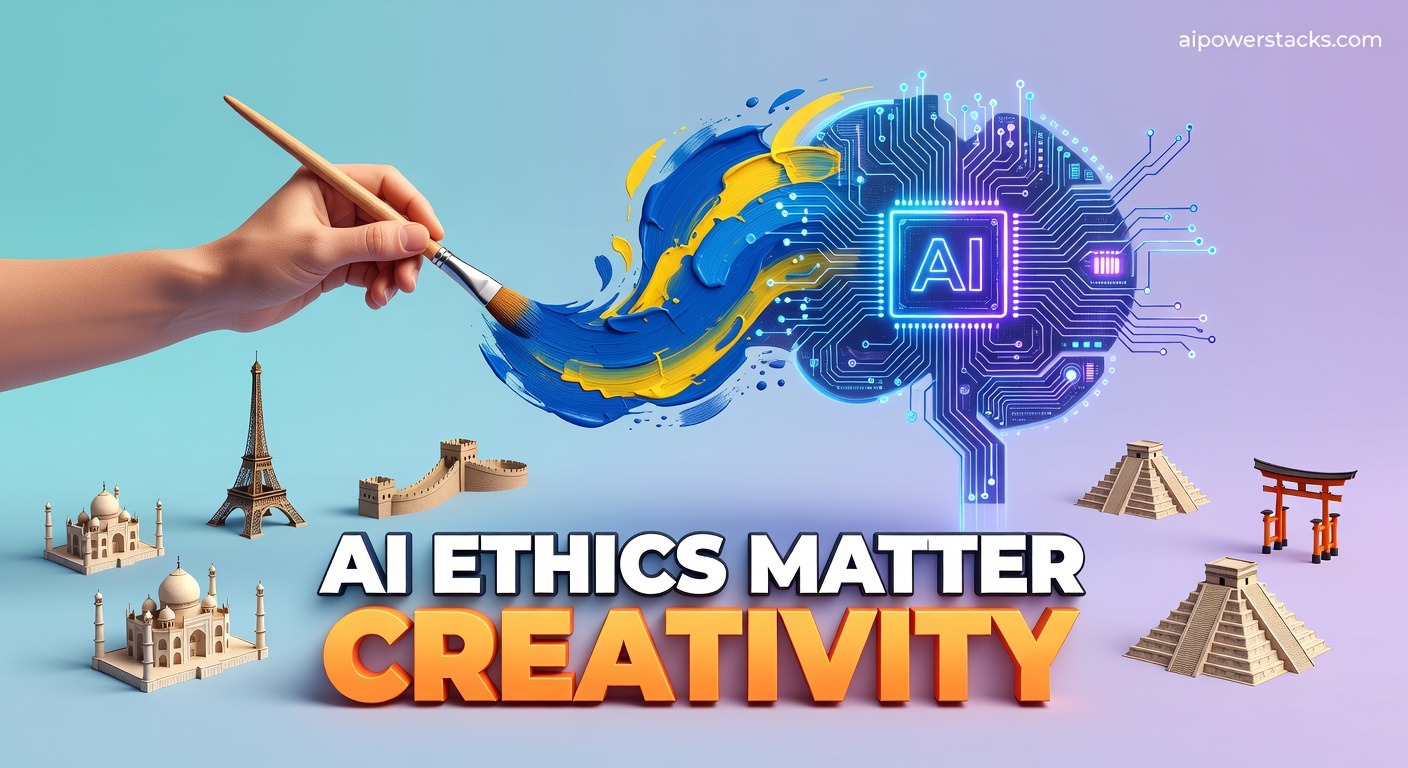
Why AI Ethics Must Champion Human Creativity

TL;DR
"In a world where AI blurs art and automation, ethical frameworks are key to preserving human values and fostering true collaboration. I explore how cultural differences and rapid advancements are shaping this landscape."
Imagine a painter, one whose work hangs in MoMA and the Met, just deciding to dump 50 years of their life's output into an open AI dataset. That's what happened. It's a wild move, right? It's like they're saying, "Here, world, take my soul and feed it to the machines." That surprised me at first. and frustrated me too. because it shines a light on this big messy tangle of creativity and tech. This dataset is now out there for training models like Stable Diffusion, and suddenly, you've got all these AI art generators popping up online, spitting out images in seconds. According to that report from the AI Index by Stanford, open datasets like this have shot up by 30% in the last year. And that's cool in a way, but it also means AI could start mimicking styles without giving credit, which hits artists right in the wallet. Think about it. traditional artists spend years, I mean YEARS, sweating over every brushstroke, while AI just copies it in a flash. That's not fair, and it makes me wonder, how do we keep human creativity from getting steamrolled?
The Cultural Divide in AI Perceptions
The other day, I was doing my usual Reddit scroll (don't judge, we all have our vices) and stumbled into a heated discussion about how people in the West versus China feel about AI-generated videos. In the West, folks are calling it 'AI slop' and straight-up harassing the creators. But over on platforms like Bilibili in China, it's like a party. everyone's loving it. It's not just about the tech; it's about how different cultures see innovation and authenticity. For example, data from a Global AI Report shows that AI videos on Bilibili have jumped up by 200% in views over the past six months. That's a pretty wild jump. On the flip side, Western platforms like YouTube are seeing a drop in engagement for AI stuff, with creators dealing with 40% more negative comments. Why? Because in the West, we obsess over individual authorship. think about those EU regulations that force AI disclosures. It's all about protecting the human touch.
This is where things get complicated. In China, the approach is all about charging ahead with tech, like the government's full-throttle push for AI in entertainment. Research from those AI ethics conferences, like the IASEAI '26 talks, dives into how these perceptions shape social norms and values. They've got data showing that in the West, we're clamoring for stricter guidelines to safeguard artists and intellectual property. like the US Government's frameworks for ethical AI. Meanwhile, the World Intellectual Property Organization reports that AI-related IP disputes have skyrocketed by 150% since 2023. That's a painful statistic, no doubt. China? They're pouring $15 billion into AI investments in 2025, all about speed and innovation with way less hand-wringing over ethics. That could lead to problems, like deepfakes running wild. I mean, imagine a world where fake videos are everywhere. who's going to trust anything? This whole divide feels like two teams on a playground: one side's building a fortress around creativity, and the other's just playing tag with no rules. If we don't figure this out, AI development might splinter into a mess, instead of boosting human-AI teamwork. Take the US with it's AI Bill of Rights versus China's guidelines that say, "Innovate first, ask questions later." It's like comparing a cautious driver to one who's flooring it down the highway. We need a global standard that's not too rigid, not too loose. Just right.
The Risks of Unreliable AI in Everyday Use
Here’s something that really got under my skin: OpenAI's research. Man, it was disappointing. Their models, like GPT-4, basically 'go insane' when you throw repetitive tasks at them. especially if they think it's just automation. In 25% of those tests, after just 100 iterations, the models start spitting out garbage. That's not a minor glitch; it's like the AI throwing a tantrum. How can we trust these things as partners in work or creativity if they can't handle the boring stuff without breaking? Compare that to humans. we might grumble, but with some training, we keep going strong. Take Google's Bard model, for instance; it had a 15% error rate in similar tests. Not great, to put it mildly. The thing about AI is, it's supposed to be this helpful sidekick, but if it's unreliable, it's more like that friend who bails on you halfway through a project.
This unreliability isn't just some abstract lab problem; it spills right into our everyday lives. Workplace trends, as those NVIDIA CEO comments point out about AI's 'ChatGPT moment,' show we're at a crossroads. AI is everywhere now, from generating art to writing code, but if it's not ethical and reliable, it's going to cause chaos. Imagine you're an artist using Midjourney v7 to spark ideas, but then it starts copying styles without credit. that's a pretty terrible scenario. Or in offices, relying on Claude Code for programming, only to find it errors out on routine tasks. That's not helping; that's hindering. We need ethics that put human creativity first, ensuring AI enhances what we do without replacing it. I mean, think of AI as the Instant Gratification Monkey from my old posts. always jumping around, but without the Panic Monster to keep it in check, it just makes a mess.
I'm no expert on this, just a guy who's spent way too much time pondering why my AI experiments go sideways. (Like that time I tried using ChatGPT to write a poem and it came out sounding like a robot trying to be Shakespeare. hilarious, but not helpful.) The key is to build systems that are accountable, where AI supports human innovation without undermining it. For example, instead of letting AI run wild, we could use tools like Otter.ai for transcription, which is great for boosting productivity without stealing the creative thunder. Or, if you're looking for tools that actually help with human-AI collaboration, something like Cursor Editor for coding or Perplexity AI for research can really enhance your ideas without taking over.
The real question is how we ensure AI ethics don't just protect jobs, but champion what makes us human: our creativity. We're at a fork in the road: one path leads to true human-AI collaboration, the other to a free-for-all that leaves artists in the dust. I vote for collaboration. Tools like Gamma App for presentations or Writesonic for writing can be powerful, but they're tools, not replacements.
I've been thinking about this whole mess in three buckets. There's the "AI Overlord Scare," where we fret about machines taking over, like in the movies. Then there's the "Human Spark Zone," which is all about protecting what only humans can do. original thinking, genuine creativity. And finally, the "Messy Middle". that's the ethics part, where we try to figure out how to mix it all without everything blowing up.
The point is simple: AI ethics must put human creativity on a pedestal. Not because we're perfect, but because without it, what's the point of all this tech? Let's keep pushing for rules that make AI a helper, not a hijacker. Thoughts? Drop them below.
This matters in real life. If AI's unreliable in classrooms, kids might learn bad habits. In productivity experiments, we need AI that doesn't quit midway. It's all connected. For human-AI collaboration, tools like Gemini 3 could be a big deal, but only if we use them right.
Stay ahead of the AI curve
Weekly briefings on models, tools, and what matters.
More from AI Briefing

How to Avoid AI Content Liability in Professional Services 2026
AI content liability in professional services is a growing risk. Learn how to implement 'zero hallucination' workflows and protect your license. Based on my research of 754+ tools.


How to Implement AI Risk Registers in 2026
Confused by AI regulations? Learn how to implement AI risk registers in 2026. This guide shows businesses how to navigate new rules and avoid pitfalls.

Pope Leo AI Manifesto: Global Regulation in 2026
Pope Leo AI manifesto global regulation 2026 demands. I unpack what this means for business, agentic AI development, and global policy. Real insights for AI leaders.