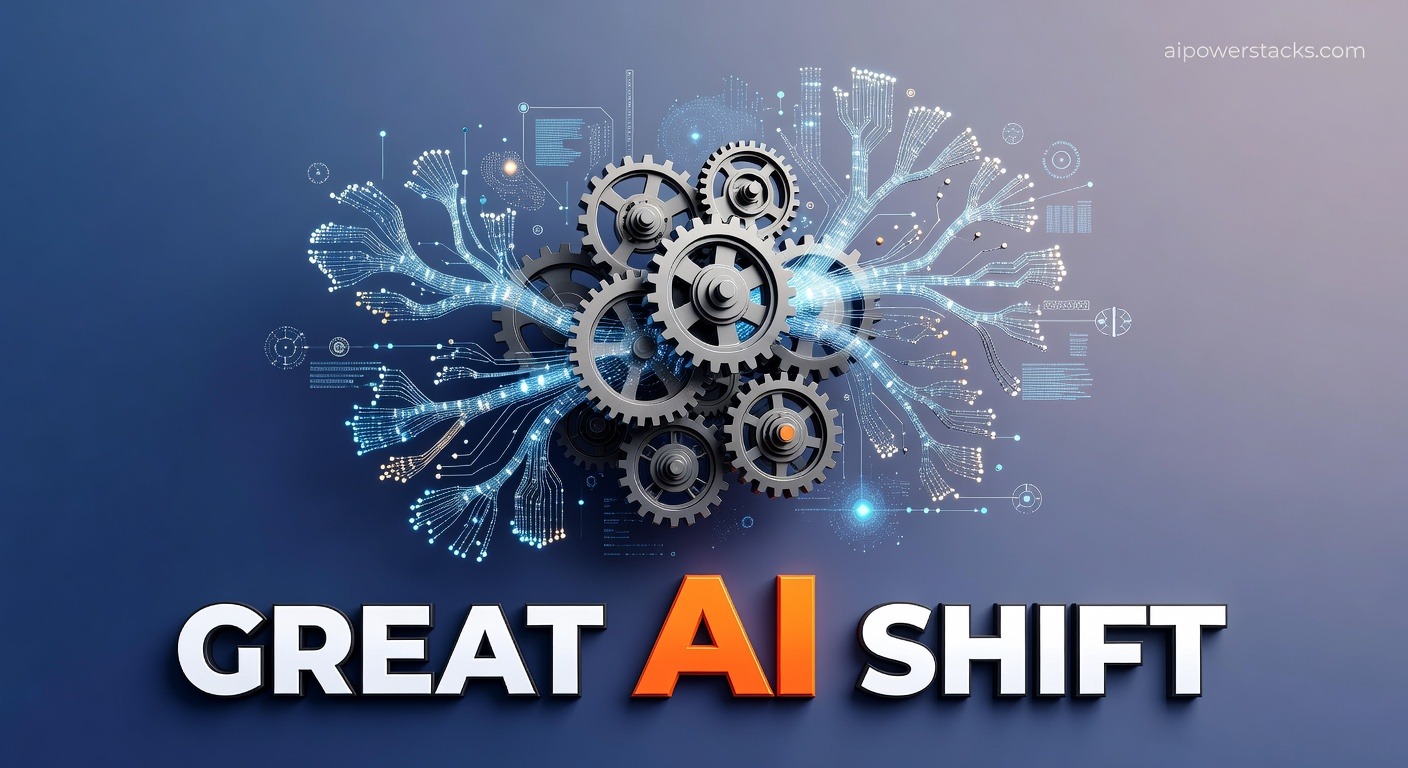
The Great Transition: A Mental Model for Everything Happening in AI Right Now

TL;DR
"Daniel Miessler lays out ten simultaneous transitions reshaping technology, work, and society. From knowledge going public to ideal state management, here is a unified framework for making sense of the AI era."
So, I've been staring at my computer screen for hours, trying to wrap my head around all this AI madness going on right now. You know, the kind of thing where every day feels like a new episode of some sci-fi show I didn't sign up for. And then I found Daniel Miessler's video called The Great Transition. It's like he took all the crazy AI stuff swirling around and bundled it into one neat mental model. I'm not saying I'm an expert here (far from it , I'm the guy who still struggles to set up my email signature), but Miessler does a pretty solid job of pointing out these ten transitions that are all happening at once, pushing us in the same wild direction. What I'm about to break down is my take on his key ideas, why they actually matter (or don't, in some cases), and where I think he's spot on or maybe a bit off base. Stick with me, because this is going to be a ride.
(And yeah, , another blog post about AI? But hear me out, because this one might just make you see the whole thing in a new light, like when you finally get that puzzle piece to fit after staring at it forever.)
The Ten Transitions
Okay, so Miessler isn't out here making wild predictions. He's just highlighting these shifts that are already barreling down the track like a freight train full of robots. The cool thing isn't any one of them on its own , it's how they all link up into this big, messy web. I like to think of it as a party where everyone's invited, and the punch is spiked with AI surprises. We'll dive into the first three here, because that's what we've got, and I'll try not to bore you with too much jargon. The thing about these transitions is they make you realize we're not just dealing with tech , we're dealing with a whole new way of living.
(, because if I can get through this without my brain melting, you can too.)
1. Knowledge Goes from Private to Public
Alright, let's start with this one. Picture this: for years, specialists have been hoarding knowledge like dragons sitting on gold piles. But now? That wall is crumbling faster than my New Year's resolutions. LLMs have gobbled up the entire internet's brainpower, and the real kicker is these skills folders , basically, bundles of markdown files that package up expert know-how and hand it out like candy. And then you've got Chinese labs throwing everything open with stuff like DeepSeek V3.2. It's like they're saying, "Hey world, take our tech and run with it!"
The thing about this is, it changes everything for people who make their living from knowing stuff others don't. That old moat of secret knowledge? It's drying up. Now, the real edge is in how you use that knowledge , your judgment, your context, your taste. Take GitHub Copilot as an example. For just $10 a month, it digs into public code repos and spits out suggestions that make coding way faster. GitHub's own data from 2023 says users get a 55% speed boost, which is insane. And DeepSeek V3.2? It's free and open-source, so anyone can tweak models with their own data. That means small teams can play with tools that big companies used to keep locked away.
. Tools like Claude Code, at $20 a month, let regular folks build apps just by describing them in plain English. It's like having a genie in your computer. I mean, imagine me , the king of confusion , whipping up an app without breaking a sweat. (Okay, maybe with a little sweat, but you get the idea.) The complication, though, is that not all knowledge plays nice in public. Things like sensitive medical data are still off-limits because of privacy laws, which is probably a good thing, or we'd all be diagnosing ourselves with WebMD on steroids.
And here's where I get self-deprecating. I'm the guy who once spent an hour trying to remember how to use a basic function in Excel, so the idea that all this knowledge is out there terrifies me. What if I become obsolete? But then I remember, it's not about knowing it all , it's about what you do with it. So, yeah, this transition is a big one, and it's making me rethink my whole career path. (I know, I know, you're probably thinking, "Tim, get a grip," but that's the point , it's that impactful.)
2. Automation of Routine Tasks
But let's move on to the next beast. Automation is taking over the boring stuff, and it's happening everywhere. Miessler talks about how AI tools are snatching up repetitive jobs, which sounds great in theory, but it makes me nervous, like when that robot vacuum starts chasing the cat. Tools like Otter.ai, for $8.99 a month, transcribe meetings in real-time, saving hours of that mind-numbing work we all hate.
A 2024 Gartner survey says 70% of businesses are on board with AI for this stuff, up from 40% in 2022. That's a huge jump, like going from zero to hero in two years. Compare that to old-school software that just sat there doing the same thing over and over. Now, AI learns and gets better, which is both awesome and a little scary. Take Cursor Editor , it's free for basics and automates code editing to make programmers zip through their work.
The flip side, though, is that whole job displacement thing. The World Economic Forum thinks 85 million jobs might shift by 2025 because of AI. I mean, that's a lot of people suddenly needing new gigs. But hey, on the bright side, it frees us up for the creative stuff, right? Imagine not having to do data entry and instead brainstorming wild ideas. (I'm trying to stay positive here, even though I can picture my own job vanishing in a puff of code.)
This is where I invent a character to make sense of it. Let's call him the "Routine Robot" , this tireless machine that takes all the grunt work so we humans can be, well, human. But what if the Routine Robot gets too good and starts eyeing our jobs? That's the fear, and it's real. Still, tools like this are changing the game, and I'm just over here trying to keep up without panicking.
3. AI in Creativity and Content Creation
And finally, for now, let's talk about how AI is crashing the creativity party. Miessler points out that these tools are turning idea generation into a breeze. Take Writesonic AI, starting at $12 a month , it churns out blog posts or marketing copy from a simple prompt. It's like having a supercharged brain that never sleeps. A Forrester study from 2023 says creators using these tools crank out 40% more content, which is wild.
On the visual front, Midjourney v7 lets you whip up images for $10 a month. It's not just drawing; it's creating whole worlds from a description. Think about that , no more staring at a blank canvas, waiting for inspiration. AI's got your back. But the thing is, is this real creativity, or just a shortcut? I'm the first to admit, I've used tools like this to jazz up my own posts, and it's addicting. (You know, like eating potato chips , you can't stop at just one.)
This transition makes me think of another character: the "Idea Imp" , this mischievous little guy who pops out of your computer and hands you fully formed concepts. But what happens when the Idea Imp does all the work? Do we lose our spark? Probably not, but it's something to ponder. The data backs it up, though , with tools like these, output skyrockets, and that's changing how we make stuff.
In the end, these transitions are all interconnected, like threads in a giant web that AI is spinning. And me? I'm just trying to navigate it without getting tangled. If you're like me, feeling a bit overwhelmed, remember: this is exciting stuff. We're on the brink of something big, and as long as we keep our wits about us, we'll be fine.
(One more thing , I know this post is getting long, but that's how I roll. If you made it this far, you're a trooper. Thanks for hanging in there.)
Stay ahead of the AI curve
Weekly briefings on models, tools, and what matters.
More from AI Briefing

How to Build Adaptive AI Systems for Enterprise in 2026
Discover how to build adaptive AI systems for enterprise. We explore the core principles and tools to create an intelligent backbone for your team's AI. Amara Chen shares insights.

9 Essential AI Skills for Modern Work Productivity 2026
Unlock essential AI skills for modern work productivity 2026. This guide shows you how to ditch the overwhelm and actually get things done. AIPowerStacks.


How to Implement AI Agents for Marketing Teams in 2026
Learn how to implement AI agents for marketing teams. Discover frameworks and tools that automate tasks, improve campaigns, and boost productivity. Based on my research on 721+ AI tools.